Nut Sort: Color Match Game
- 4.9
- Rating
- 1.00M
- Installs
- Free
- Price

 Analysis by App-foxy
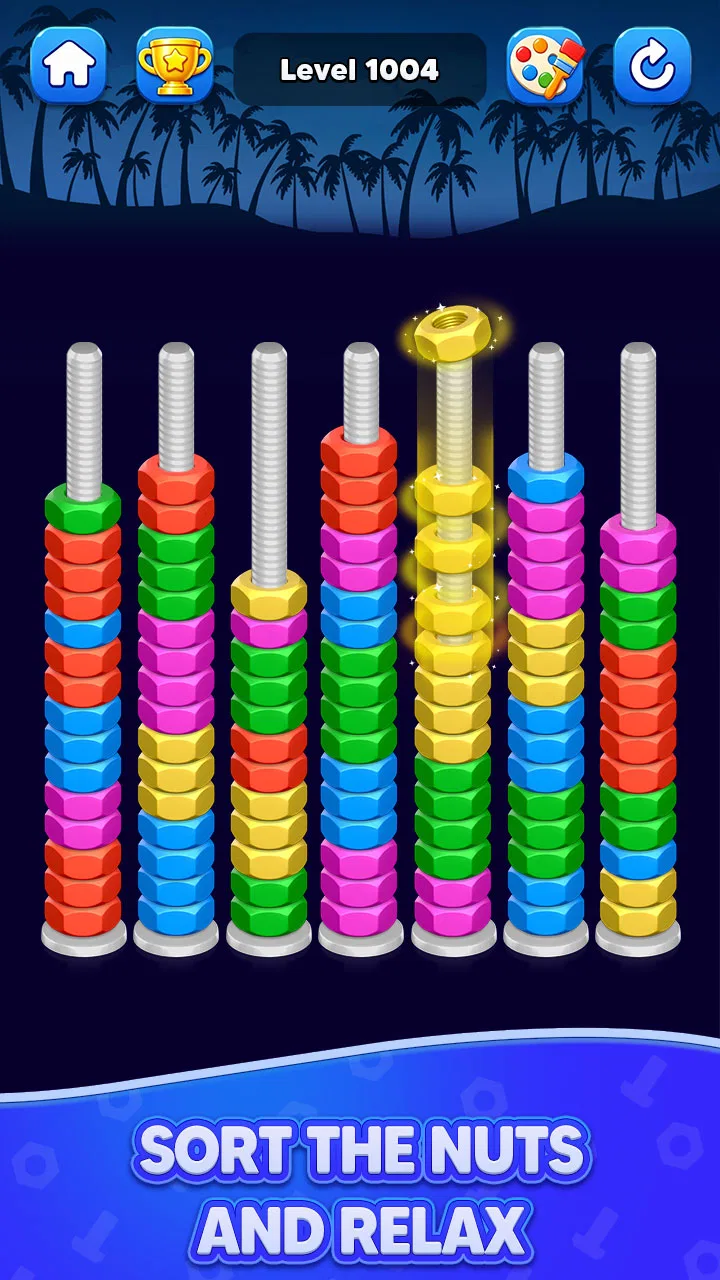
I first understood the appeal of Nut Sort: Color Match Game after a very simple move: I picked up a colored nut stack and moved it onto another tube. The action is easy to understand, but the result depends on planning. Matching colors feels immediately satisfying, while a careless move can leave the board crowded and make the next decision much harder. That small tension is what turns this into more than a quick color-matching exercise.
This is a free trivia-style puzzle game from Greyfun Games, designed for short bursts rather than long explanations or complicated controls. It is suitable for Everyone, works on devices running Android 6.0 or later, and has reached over 500 thousand installs. Its average rating is 4.9 from around 9.9 thousand ratings, which suggests that the straightforward format has found a receptive audience. I can see why: the game gets to its central idea quickly and lets the player learn by doing.
How the first move creates the challenge
The basic task is to sort colored nuts into matching groups. You tap or select a stack, choose a destination, and watch the pieces shift. The first move usually feels obvious because the board presents a visible mismatch that needs correcting. The second or third move is where the puzzle starts asking a real question: am I solving the current color, or am I protecting the space I will need later?
You May Also Like

 Blood Strike: 2.5 Anniversary
Blood Strike’s Loadouts Turn Every Drop Into a Tactical Gamble
A close look at Blood Strike’s custom loadouts: how fast access to signature weapons reshapes its battle royale rhythm, rewards preparation, and narrows the gap between fights.

 Pandora - Music & Podcasts
Pandora’s Music Is Easy to Start, but Harder to Recover
Pandora’s strength is its low-effort path from a seed to a station. Its weak spot is how much confidence it asks you to place in connection, setup, and quiet recovery.

 8 Ball Pool
 Is Built on Rivalries, Rematches, and Routine
A close look at the rivalries, rematches, shared routines, and unanswered safety questions that turn a quick pool match into a persistent mobile community.

 Samsung Music
’s Quiet Strength Is Playing What You Already Own
Its reach comes less from spectacle than from dependable access to a personal library. That simplicity is both the app’s strongest retention engine and its ceiling.

 AccuWeather: Weather Radar
AccuWeather Review: A Quick, Clear Forecast for Everyday Decisions
For everyday plans, the best forecast is the one you can understand quickly. AccuWeather makes rain timing, radar, and local conditions easy to act on, with a few trade-offs.

 Hill Climb Racing
Why Hill Climb Racing Still Turns Crashes Into One More Run
A tiny car, a bumpy hill and one more upgrade: Hill Climb Racing keeps resurfacing because its simple chaos makes every near-miss feel personal.
More From Our News Desk
View All News


That distinction matters. A move can look successful because it places two matching nuts together, yet still be unhelpful if it blocks access to another color. I found myself reading the top of each stack before acting, checking which colors were exposed and which were buried. The game does not need complicated rules to create this mental checklist. Its difficulty comes from arranging a limited number of useful spaces while trying not to create an awkward pile.
The controls are approachable enough for someone who rarely plays puzzle games. There is no long tutorial to memorize, and the visual goal is clear from the arrangement itself. That makes the opening seconds comfortable on a phone, especially when I want something I can start without committing to a story, character system, or lengthy explanation.
At the same time, the simplicity can be misleading. New players may assume that matching the first available color is always correct. My more reliable approach was to pause before the opening move and identify the colors that are partially hidden. Clearing a visible pair is useful, but preserving access to those buried pieces is often more important. The strongest early habit is to plan one move beyond the match you are making.
This is also where the game separates itself from a typical reaction-based color game. There is no need to tap quickly or chase a timer in the basic experience I played. The pressure comes from making the board less flexible. That makes it a better fit for people who enjoy quiet visual problem-solving than for players looking for speed, competition, or constant action.
Why the board feels readable
The color grouping communicates the objective without relying on dense text. I could look at the tubes, identify the exposed nut, and understand which destinations might accept it. That visual clarity is important on a small screen, where a cluttered interface would make a simple puzzle tiring. Here, the challenge comes from the arrangement of pieces rather than from trying to decode the controls.
Still, color-based puzzles are not equally comfortable for everyone. Players with difficulty distinguishing certain colors may find close shades less convenient than symbols or labels would be. If visual color separation is a major concern for you, a game that combines colors with shapes or written markers may be a better choice. Nut Sort’s clean presentation is one of its strengths, but it also means the colors carry much of the information.
The feedback rhythm after each move
The game’s most effective quality is the immediate feedback loop. I make a move, see whether the stack settles into a useful arrangement, and then decide whether to continue the plan or change direction. When a matching group comes together, the board looks more organized. When I use a tube poorly, the remaining pieces make that mistake visible. The feedback is not complicated, but it is easy to read.
That rhythm gives each action a small consequence. A good move opens options; a weak move reduces them. Because the result appears right away, I do not have to wait for a round to end before understanding whether my thinking was sound. This makes the game accessible to casual players while still offering enough structure for people who like to improve their solving method.
I especially liked the way the board encourages a repeated scan. After every placement, I looked again at the available top colors, the partly completed groups, and the empty space. That scan becomes almost automatic. It is a useful mental routine: first identify a safe match, then check whether the move exposes a new piece, and finally ask whether the destination remains useful for another color.
One practical tip is to treat empty tubes as working space rather than as immediate targets. Filling every available space too early can make the next sequence harder. I had better results when I kept at least one flexible location available while uncovering buried colors. This is not a flashy technique, but it changes the way the puzzle feels. Instead of reacting to the top piece alone, I was managing room for future decisions.
Another useful habit is to avoid completing a color group automatically when doing so would seal an important route. Sometimes a partially matched stack is more valuable as a temporary staging point than as a finished group. That trade-off is easy to miss because completion looks rewarding. In practice, leaving a group unfinished for a moment can preserve the flexibility needed to solve the rest of the board.
The small reward that brings me back
The reward in this game is mainly the visual and mental satisfaction of making order from a mixed arrangement. A successful sequence gradually reduces clutter, and the final organization gives the session a clear sense of completion. I did not need a complicated progression system to understand why another round was tempting: I wanted to see whether I could solve the next arrangement with fewer wasted moves or fewer moments of uncertainty.
That is an important distinction from games built around collecting characters, unlocking equipment, or following a narrative. Nut Sort gives its reward through the puzzle itself. The pleasure comes from recognizing a pattern, correcting a mistake, and watching the board become coherent. For me, that made it suitable for a short break when I wanted an activity rather than passive scrolling.
The game also works well as a low-pressure reset between other tasks. I could play a little while waiting for an appointment, during a commute when conditions allowed safe phone use, or at the end of the day when I did not want a demanding game. The rules are light enough to remember after putting the phone down, so returning later does not require rebuilding a complicated strategy.
However, the same simplicity may limit the reward for players who need constant novelty. If your ideal puzzle game includes a story, elaborate objectives, competitive rankings, or a broad collection of mechanics, this will probably feel modest. Its satisfaction depends on whether you enjoy repeating a familiar structure with new arrangements. I would recommend it to someone who values a clean loop over a large feature set, not to someone expecting a full puzzle adventure.
Because it is free, the entry barrier is low. I could try the central gameplay without treating the download as a major commitment. The age rating of Everyone also makes the concept broadly approachable for families and younger players, although individual comfort with color-based play can still vary. The important point is that the game’s challenge comes from arranging pieces, not from mature themes or complicated subject matter.
What happens when a session resets
The reset is part of the attraction. Once a board is completed, the immediate problem disappears, but the desire to solve another one remains. A new arrangement gives the same rules a different shape, so I can begin again without learning an entirely new system. That repeatability is what makes the game feel suitable for both a quick single round and a longer series of attempts.
I found the reset most appealing after a near-miss. When I made an early placement that left too little room, the board became a lesson rather than just a failure. Starting again let me test a different opening order and see whether preserving space changed the outcome. This creates a useful action-feedback-reset cycle: act, observe the consequences, finish or restart, and apply the lesson to the next arrangement.
There is also a psychological benefit to the short-form structure. A difficult board does not feel like a major loss because the player can begin another attempt quickly. That makes experimentation less intimidating. I was more willing to try a risky move when I knew the result would teach me something about the arrangement rather than permanently damage a long campaign.
On the other hand, players who prefer a strong sense of long-term progression may find the reset less meaningful. The game’s core appeal is the individual puzzle and the improvement of your own approach. If you need every session to unlock a new ability or visibly advance a larger objective, a more progression-heavy alternative may hold your attention better.
The current version is 1.20.0, and the game was released on January 27, 2025. Those details place it among relatively recent casual puzzle options, while the substantial install base indicates that it has already moved beyond being an obscure experiment. I would still judge it primarily by the loop rather than by its version number: the question is whether sorting, planning, and resetting are activities you genuinely enjoy repeating.
Where it fits among familiar puzzle alternatives
Compared with match-three games, this experience is slower and more deliberate. Match-three play often rewards scanning for combinations and making quick chains, while Nut Sort asks me to manage positions and future access. A player who enjoys planning several steps ahead may prefer the tube-and-stack format. Someone who wants explosions, cascading matches, or rapid visual effects may find the pace too restrained.
Compared with classic tile-sliding puzzles, the goal is easier to read because the colors show the intended groups. The trade-off is that the puzzle offers less variety in its basic action. Tile games challenge movement and spatial transformation; this one focuses on transferring stacks while protecting empty space. I would choose it for a more tactile sorting feeling and choose a tile puzzle when I want a compact grid with more geometric movement.
It also differs from word trivia despite belonging to the broader trivia area. There are no questions to answer or facts to recall in the way many trivia games use that label. The mental task is visual organization. That makes it a better option for players who want a brain exercise without knowledge tests, and a poor substitute for anyone specifically seeking quizzes, categories, or competitive question rounds.
For younger players, the clear objective can make it easier to approach than a strategy game with many menus. For adults, the same clarity makes it useful as a brief decompression activity. In both cases, I would suggest focusing on the process rather than trying to solve every board as quickly as possible. The most satisfying improvement comes from reducing blocked positions and preserving options, not from rushing the first few moves.
Who should play it, and who should skip it
I would recommend this game to people who like color organization, calm puzzle solving, and sessions that can begin without preparation. It is particularly suitable if you enjoy noticing patterns and learning from small mistakes. It also works for someone who wants a free game with an Everyone rating and a low learning curve, provided that color-based information is comfortable to read.
I would be more cautious about recommending it to players who need constant action, social competition, or a deep progression system. It may also disappoint anyone who expects a trivia game built around questions, because the thinking here is spatial rather than factual. And if you tend to dislike repeating the same core mechanic, the reset-and-retry structure may feel narrow after the initial curiosity fades.
For my own use, the best scenario is a short pause in the day: I open the game, solve a board while keeping my attention on a simple task, and stop when the arrangement is complete. I would not choose it for a long evening when I want a substantial adventure. I would choose it when I want a focused activity that gives me a clear beginning, a series of understandable decisions, and a satisfying finish.
My final view is positive, with a clear qualification. Nut Sort: Color Match Game succeeds because every move matters just enough: the action is simple, the feedback is immediate, the completed arrangement provides a modest reward, and the reset makes another attempt feel natural. Greyfun Games has built a focused color-sorting puzzle rather than an overloaded package, and that focus is exactly why it works for casual sessions.
It is not the right choice for every puzzle fan, especially if you want story, speed, trivia questions, or extensive long-term progression. But if you like turning a messy board into an organized one and enjoy improving your opening decisions from round to round, I think it is worth trying. The free download makes that decision easy, and the game’s strongest quality is that it explains its appeal through play rather than through promises.
FAQs for Nut Sort: Color Match Game
01What is the main objective of Nut Sort: Color Match Game?
The main objective of Nut Sort: Color Match Game is to sort various colored nuts into their corresponding baskets by matching colors. Players need to strategize their moves to complete levels with increasing complexity. This puzzle game is designed to challenge your cognitive skills and offer a relaxing yet engaging gaming experience.
02Is Nut Sort: Color Match Game suitable for all age groups?
Yes, Nut Sort: Color Match Game is suitable for players of all ages. Its intuitive design and simple mechanics make it accessible for younger players, while the challenging levels provide enough depth for adults seeking a casual yet stimulating puzzle game. It’s family-friendly and perfect for players looking to improve their color recognition and sorting skills.
03Are there any in-app purchases or ads in Nut Sort: Color Match Game?
Nut Sort: Color Match Game includes in-app purchases that allow players to buy additional hints and power-ups to enhance gameplay. The game also features ads, which can be removed through a one-time purchase. These options provide a choice for players who wish to enjoy an uninterrupted gaming experience.
04Can Nut Sort: Color Match Game be played offline?
Yes, Nut Sort: Color Match Game can be played offline, making it an ideal choice for users who want to enjoy the game without an internet connection. This feature allows players to engage with the game during travel or in areas with limited connectivity, ensuring uninterrupted puzzle-solving fun.
05What platforms support Nut Sort: Color Match Game?
Nut Sort: Color Match Game is available on both Android and iOS platforms. It can be downloaded from the Google Play Store for Android devices and the Apple App Store for iOS devices. Ensure your device meets the minimum system requirements for a smooth gaming experience.
Pros
- Engaging and addictive gameplay.
- Colorful and vibrant graphics.
- Simple controls for easy play.
- Challenging levels to test skills.
- Suitable for all age groups.
Cons
- Ads can be intrusive at times.
- Limited free hints available.
- No offline mode available.
- May drain battery quickly.
- In-app purchases can be pricey.

Nut Sort: Color Match Game
Gallery